Olivia’s reading journey

By Olivia Vigrass

The latest in our reading journeys from the Sheffield Hallam University students taking part in the Ideas into Action initiative.

As a child, I was surrounded by reading in school and out of school. Of course I went through the standard practice of learning how to read when I started primary school like most other children in this country. I was also familiarised with reading at home, as my parents used to read to me before I went to sleep, some of the books including The Little Princess series, those being some of the key books I remember from that long ago.

As I grew older, particularly when I was about 11 or 12, when I started year 7, me and my group of friends all took an interest to reading young adult books and tended to share our thoughts on them. One particular key series that sparked my love of reading was The Hunger Games trilogy, which me and my friends read and then we would anticipate the release of the films and go and see them together multiple times. It seems like in 2012, young adult reading really took off, and I was a huge fan of all the dystopian novels released and publicised around that time. An author that remains strong in my memory of that time was John Green, the book that left the biggest mark on me of his was the teen romance of The Fault in Our Stars. Until I read that, I had never thought a book would inflict so much emotion and make me cry! It is also a nostalgic experience for me, when these authors bring out books now, as I love to read them and it really takes me back to my early teens. In comparing myself with Elsie Brownlee’s reading journey, it is easy to see that our generational differences create very different reading journeys. In comparison to Elsie who grew up in the early 1930s, it is clear that I had more freedom when it came to reading books and so did my friends. Elsie’s journey focuses around the library setting and her love of books that stemmed from there, ‘At about the age of eleven, Elsie became a fervent library user.’ Me and my friends all purchased our books with pocket money, showing that we had a bit of power in buying exactly what we wanted to read.

As I got older and entered High School, I constantly had a book on the go, and I really think my love of reading began to grow even more. When I was 16, I read the Harry Potter books for the first time, which was strange considering that the franchise had been around for so long! I had never read them because I thought they were a bit childish and overhyped but I was completely wrong. Even now, I still find comfort in reading them as they are a great escape from the world around us, especially in times like these. Another popular book series that I deemed as overhyped was the Twilight series, but I read all of these around about when I was 17 and I completely fell in love and they are still some of my favourite books I’ve ever read!

When I was at the point of deciding what I wanted to study at university, I was in no doubt that English Literature would be the one for me and I have never regretted this decision as it has opened so many genres and books to me that I never would have picked up. Some including classics such as Wuthering Heights and gothic novels which I had never even heard of such as The Castle of Otranto and Beloved. I believe that this degree has opened my mind to authors and contexts that I was ignorant of before. It is also so lovely that I can talk to like-minded people about reading and books that I couldn’t do before.

Currently my reading interest is horror novels, particularly by Stephen King. So far I have read Carrie and The Shining, and I am now reading Pet Sematary. I feel like being in lockdown has really re-sparked my love of reading as it is a great escape for me.

When I leave Sheffield Hallam University, I am going to do a masters in Global Media and Culture, as I would love to become a writer for a social media company. Elsie, who I mentioned earlier, had a dream to work in a library. Elsie: ‘I thought, “I’d love to work in a place like this. I’d LOVE to work in a place like this.”’ (2015). Even though libraries are still working today, it is much more accessible to buy books from online, physical copies and e-books alike. As we are both women, it is interesting to see how her father practically chose her job for her, yet I have the choice to do whatever I would like to in the future, ‘Elsie’s father thought further education for girls a waste of time as they were bound to get married’ (2015).  I feel lucky to have a different approach on the life I want to live.

The commercialisation of Anne of Green Gables

By Natalie Haigh

Here is another blog post by Natalie Haigh from Sheffield Hallam University through their Ideas into Action project.

Anne of Green Gables, written by Canadian author Lucy Maud Montgomery and published in 1908, is a wonderful and heartwarming novel that is full of adventure and beautiful landscapes. Moreover, it is a novel that has firmly secured a place in the hearts of millions of readers around the world. The novel’s popularity speaks for itself. Anne of Green Gables has been translated into 36 different languages and has sold over 50 million copies worldwide, making it an undisputed best seller and piece of popular fiction. Although the novel was originally written for readers of all ages, it proved to be exceptionally popular with younger audiences. Subsequently, the novel was established as a children’s classic in the world of literature. The novel follows the story of Anne Shirley, a 12 year old red-haired orphan girl who is adopted by Matthew and Marilla Cuthbert. Matthew and Marilla are siblings who live on a farm called Green Gables in Prince Edward Island, Canada. Anne is sent to the two siblings accidentally as they originally requested a boy. Despite the mix-up, Anne is an extremely curious, high-spirited and imaginative child who brings unexpected adventure into Matthew and Marilla’s lives. With that, Matthew and Marilla decide to keep her.

Lucy Maud Montgomery, author of Anne Of Green Gables (Credit: Library and Archives Canada / C-011299)

Upon reflection, one of the reasons why I personally enjoyed the novel so much is because of the many beautiful and inspiring themes within it. From hope and perseverance, to forgiveness, hard work and true happiness, the novel sheds light on how making mistakes and learning from them is what allows Anne to develop and blossom into a better person. Therefore, I could not help but feel touched and inspired by Anne’s fictional character and her remarkable outlook on life at such a young age.

Anne of Green Gables is the first novel in an anthology series. Due to the immense popularity of her first novel, Montgomery went on to write a series of sequels to continue the story of Anne Shirley. She wrote five more novels, in which Anne grows older in each. The overriding response to the novel is that it is a beautiful and heartwarming story. It is the character of Anne and her ability to remain in high spirits, regardless of what life throws at her, along with the beautiful themes in this novel that make it such a popular piece of fiction. And one that holds a special place in the hearts of millions of readers all over the world.

Although the novel was very popular all over the world, it was extremely well received in Japan where it is known as Red-haired Anne. According to journalist Levinson-King, one of the main reasons for the novel’s appeal and popularity in Japan is ‘because the world of Green Gables is filled with kawaii, which means the quality of being cute, romantic and beautiful in Japanese.’ He goes on to write that the Japanese ‘love the story because it is full of beautiful scenery and puff sleeves and cute things, like tea parties’ (Levinson-King, 2017, BBC News Article). Therefore, the immense popularity of the novel in Japan can be attributed to the beautiful imagery it includes which aligns with Japanese interests and beliefs. As a result of the novel’s popularity,

Japan has developed the commercialisation and commodification of Anne as a popular cultural and media image, so that an “Anne industry” has developed (Ochi, 2006, p. 361). 

The ‘Anne empire’ that has emerged off the back of Montgomery’s heroine protagonist spans merchandise, books, plays, television series, museums and musicals to name a few.

Why has this commercialisation occurred in both Japan and Canada, particularly in the leisure and tourism industry?

The real Green Gables (copyright Pam Gibson)

One extremely significant and profitable part of the commercialisation of the novel, is the tourist attractions that have been created in Prince Edward Island, Canada. The Green Gables Farmhouse where the novel is set is situated in Cavendish in Prince Edward Island, and is an extremely popular tourist attraction, particularly with Japanese tourists. Scholar Baldwin interestingly writes:

Perhaps the most surprising indication of the continued popularity of Anne is the growing number of Japanese who flock to Cavendish, Prince Edward Island, to visit the recreated home of a Canadian girl who never existed, and to examine objects she might have used had she been a real girl’ (Baldwin, 1993, p. 2).

Baldwin acknowledges how astonishing and bizarre, yet how remarkable it is that thousands of people are so invested in Anne’s fictional character, that they are prepared to fly across the world to Canada to see the recreated home that Anne’s fictional character grew up in, and pay a lot of money to do so. Baldwin goes on to shed light on an interesting question:

Why do so many Japanese people, especially young women, worship Anne Shirley, a red-haired wisp who comes from a very different culture and time period, and who makes allusions to authors, events, and people with whom the Japanese reader is unfamiliar?

Baldwin compiles the opinions of different scholars in response to this question. He writes:

There are several theories about why the Japanese are so fond of Anne. According to American writer Donald Ritchie, a leading expert on Japanese popular culture, the people’s passion for Anne can be explained by the cult of innocence, which is highly prized in Japan. 

Emiko Mori, by contrast, attributes the Japanese admiration for Anne to her frankness and spontaneity, which ‘are things Japanese perhaps find hard to be. We are afraid to be that way’ (Baldwin, 1993, p.2). Therefore, it can be suggested that there are many reasons as to why Anne is such a popular figure in Japanese culture, and this cannot be pinned down to one specifically.

But is this excessive level of commercialisation of Anne of Green Gables problematic in any way? It can be suggested that large corporations are taking advantage of Anne’s popularity through the creation of tourist attractions, and are subsequently knowingly profiting from a piece of popular fiction that they did not write or create. Therefore, this raises an interesting question as to whether it is moral and ethical to profit from someone else’s work, especially when the creator of that work is now deceased. These corporations are continuing to profit from Montgomery’s legacy and her work after her death, which could be considered to be problematic and a sensitive subject. In contrast, the commercialisation and commodification of Anne of Green Gables could be viewed as positive and beneficial. Arguably, these corporations are helping to keep the legacy of Anne’s fictional character alive. Moreover, they are providing the loyal and avid readers, who cherish the novels dearly, the opportunity to visit the story world in real life. This experience will undoubtedly evoke feelings of joy, nostalgia and excitement in those people. Not to mention all of the jobs that the ‘Anne empire’ has created, and the boost it has given to the Canadian economy in particular. As Baldwin notes,

the number of Japanese tourists to Canada grew from 2.9 million in 1976 to 5.5 million in 1986, and Japan became Canada’s second-largest source of overseas tourists’ (Baldwin, 1993, p.2).

Bibliography

Baldwin, D. (1993). L. M. Montgomery’s Anne of Green Gables: The Japanese Connection. Journal of Canadian Studies, 28(3), 123-133.

Drain, S. (1986). Community and the Individual in Anne of Green Gables The Meaning of Belonging. Children’s Literature Association Quarterly 11(1), 15-19. doi:10.1353/chq.0.0082.

Gray, P. (2014). “Bloom in the Moonshine”: Imagination as Liberation in Anne of Green Gables. Children’s Literature 42, 169-196. doi:10.1353/chl.2014.0009.

Ledwell, J & Mitchell, J. (Eds.). (2013). Anne around the World: L.M. Montgomery and Her Classic. McGill-Queen’s University Press. Retrieved from: http://www.jstor.org/stable/j.ctt24hnsz

Levinson-King, R. (2017). Anne of Green Gables: The most popular redhead in Japan. BBC News, Toronto.

Ochi, H. (2006). What Did She Read?: The Cultural Occupation of Post-War Japan and Translated Girls’ Literature. Retrieved from: http://hermes-ir.lib.hit-u.ac.jp/hermes/ir/re/14565/0100706501.pdf

Shelagh J. Squire (1996) Literary Tourism and Sustainable Tourism: Promoting ‘Anne of Green Gables’ in Prince Edward Island, Journal of Sustainable Tourism, 4:3, 119-134, DOI: 10.1080/09669589608667263

My Personal Reading History

By Natalie Haigh

Natalie is a student at Sheffield Hallam University and has been taking part in our joint project through the university’s Ideas into Action initiative. Here is Natalie’s account of how she became a reader.

My name is Natalie Haigh, I’m 22 years young and I was born in Rotherham in 1998. I grew up in Rotherham. My parents moved there before I was born and still live there to this day. My grandparents also live in Rotherham and have lived there for the majority of their lives, as my grandad worked as a solicitor nearby in Sheffield. When I was five years old, I attended a very small primary school in my local village which was a largely working class area. I then moved on to a comprehensive school close by where I completed my GCSEs. After leaving comprehensive school, I moved on to study at a college in Rotherham where I completed my A Levels. That brings me on to the present day. I am currently a second year student at Sheffield Hallam University where I am studying for a BA Honours degree in English Literature. An English Literature degree was a natural choice for me because I have always had a passion for reading and writing ever since I can remember.

My very first memory of reading was in primary school. I can vividly remember learning to read. I read the Biff, Chip and Kipper books by Oxford Reading Tree. Reading was the activity that I always looked forward to the most at primary school. I can remember the extremely cosy reading corner where my teachers read all sorts of different books to my class. My favourite was Sheila Lavelle’s novel, My Best Friend because it was filled with mischief and adventure. I loved it so much that whenever my teacher would come to the end of a chapter and tell us it was time to move on to maths class, I begged her to start the next chapter and carry on reading to us. The same teacher created a reward scheme for my class. Every time a member of our class excelled at something or made a kind gesture towards someone, she would reward them by putting a marble in a jar. We kept a record of how many marbles were in the jar and collected them, because when the jar was filled with one hundred marbles, my teacher granted us a full Friday afternoon to do anything that we wanted. This was called ‘Golden Time’. I would always go to the cosy reading corner during Golden Time, and I would sit and read books there for hours. Meanwhile, most of the other children were off painting or watching films together. I have such fond memories of Golden Time because it was a rare occasion when I could read at school all afternoon without any distractions, in a comfortable and cosy environment.

My parents and grandparents always read to me too. My grandparents had a house full of books and I would often stay over at their house. I remember being fascinated by their bookcase. As a small child, their bookcase seemed huge in comparison to me. I have always been very inspired by my grandad and what he achieved in his career. He always told me that he learnt everything he knew from books and reading. Therefore, he was always very encouraging when it came to reading and was keen for me to read as much as possible. One thing he taught me to always do when reading, which stands out in my memory the most, is that when I come across a word I do not know the meaning of, I should look up its definition in the dictionary and make a mental note of it. This is something that has stuck with me and that I continue to do today. My grandad always had either a book or newspaper in his hands, and my grandma has a love for glossy fashion magazines. My grandma has an extremely vivid imagination and she would tell me fascinating stories about her childhood and the adventures she got up to. Reading the Biff, Chip and Kipper books and hearing the stories of what my grandma got up to when she was younger sparked my interest in adventure stories. I went on to read Enid Blyton’s The Magic of the Faraway Tree and Joyce Lankester Brisley’s series, Milly-Molly-Mandy. I noticed that the Milly-Molly-Mandy book series was also loved and treasured by one of Reading Sheffield’s interviewees, Margaret C. When I was around ten years old, I was given Beaver Towers by Nigel Hinton to read by my favourite teacher, another children’s fantasy novel that I absolutely adored and could not put down.

Moving on to comprehensive school, I was given the novels Animal Farm by George Orwell and Of Mice and Men by John Steinbeck to read. As much as I enjoyed reading and studying these novels, my personal reading tastes evolved and I became far more interested in reading thought-provoking self-help books, books about business and enterprise, and autobiographies of people who inspired me. In fact, I actually went through a phase of feeling guilty about reading non-fiction. I battled with personal insecurities that stemmed from me thinking those books were not academic enough for me to tell people I was enjoying reading, or even to include in this blog. However, I eventually came to my senses and realised that those were the sorts of books I enjoyed, and that ultimately, were a huge part of my personal reading journey. I was reading so much fiction in school such as Animal Farm and Of Mice and Men, that I had a yearning to read something new and refreshing. I noticed that Reading Sheffield’s interviewee, Jocelyn Wilson, also spoke about reading the right sort of books. She says

I did a project on keeping a notebook of all the things I’d read… I know that it was criticised by the person who taught English at school, saying, “I can’t think why you read all this rubbish when you’re capable of reading something so much better” (Hewson, 2015, Jocelyn’s Reading Journey).

I strongly resonated with this part of Jocelyn’s reading journey as I personally felt a lot of pressure to read fiction, especially in school. Therefore, I did not want to discuss the sort of books I was actually reading and enjoying with my school teachers, purely out of shame and fear that they would be unimpressed and disappointed that a lot of the books were non-fiction.

One contrasting factor of my own personal reading journey to those of Reading Sheffield’s interviewees, is that I am from a different generation. The rise of social media and advances in technology changed the way I was reading. Rather than going to my local library and taking out books to read, I found myself reading most books on my Kindle. I also read a lot of different people’s online blogs. Blogs were a new and exciting medium to experience. Moreover, I could easily interact with the authors of the blogs and engage in conversation with them about their works by commenting and receiving instant responses. I quickly discovered that an entire online community for authors and readers existed in the world of blogging, sort of like lots of online book clubs. Therefore, reading started to feel more like a social activity than an independent one. Moreover, so much of the reading that I do is online now, which is one of the main ways that my reading history contrasts to many of Reading Sheffield’s interviewees. Now, the vast majority of my time is taken up by reading books, plays and academic works for my degree. For me personally, whenever I go on holiday is the time that I really indulge in reading books that I genuinely want to read. I take a few books away with me every holiday and I usually get through them all. On holiday, I don’t have to worry about anything else. I can get completely immersed in a book whilst soaking up the sun. And it is during times like those when I remember why I fell in love with reading.

Bibliography

Grover, M. (2019). Margaret C’s Reading Journey. Reading Sheffield. Retrieved from: https://www.readingsheffield.co.uk/margaret-cs-reading-journey/

Hewson, V. (2017). Jocelyn’s Reading Journey. Reading Sheffield. Retrieved from: https://www.readingsheffield.co.uk/jocelyns-reading-journey/

‘A completely new novel to me’

By Archie Harris

Here is another of our Sheffield Hallam student guest posts – the first in which a student of today reviews a book or author popular with our original 20th c readers. Archie chose to write about L M Montgomery’s Anne of Green Gables.

Anne of Green Gables was a completely new novel to me at the beginning of this process, with me having neither heard of the novel or Lucy Maud Montgomery herself. However, I am incredibly grateful to be involved in this course as I feel lucky to be exposed to such a plethora of new and intriguing tales I may have never discovered throughout my regular day to day life. The first in a series of seven novels chronicling the adventures of titular character Anne Shirley, Anne of Green Gables is generally considered a classic of their youths for many people born in the 20th century. Perhaps the best way to illustrate the quality of the novel is through its sheer longevity. Originally released in 1908, Anne of Green Gables has withstood the test of time and still remains a classic read for younger generations starting their journeys into a love of fiction. This permanence is not only due to the high quality of the writing and storytelling but also the nostalgic warmth it brews in many parents, compelling them to read it to their children and have them fall in love with it too.

With the high volume and high intensity of university work, I usually do some research and preparation before reading a book, frequently spoiling the plot for myself to make the process of analysing and discussing the novel more streamlined. However, for this I decided to take myself back to my childhood and simply dive headfirst into the pages with no prior knowledge or expectations whatsoever. And what a joyous experience it was, watching young Anne subvert the prejudices of those around her and win their hearts made me feel like a child again, a sensation I have been chasing since I flipped the last page.

From the moment we are first introduced to Anne until the very end of the novel we cannot help but to support her in everything she does and wish her the best. This feeling is paralleled by Matthew Cuthbert who, despite mistakenly adopting Anne when in search of a young man to help with the farm work in his old age, falls in love with her rampant imagination and spirited soul before the pair can even make it back to his home from the train station. Anne even manages, eventually, to win the affections of Marilla Cuthbert despite her stern and traditionalist approach. Watching their relationship develop over the course of the novel was humorous, touching and come the end of the novel, utterly heart-shattering.

The epitome of Anne’s character and the reason she is so endearing and means so much to so many is her complete selflessness and unwillingness to take anything lying down. Her back and forth rivalry-come-friendship with Gilbert Blythe, whom I notice is much revered by those of Reading Sheffield, particularly Val seems to have had a soft spot for this young gentleman, is one of the most satisfying relationships we see blossom over the novel. We see an immensely strong friendship and mutual respect develop over years from the childish teasing of Gilbert calling Anne ‘Carrots’ in reference to her red hair, which led to him getting a slate smashed over his head, to the pure altruistic act of him giving up his job so she can work closer to Marilla and care for her as she is going blind and has lost her brother Matthew. This coupled with Anne giving up her life’s dream and everything she has worked for since moving to Avonlea to make sure her adoptive mother receives proper care demonstrates exactly why both of these characters, and the novel as a whole, are so effortlessly charming and endearing.

It was therefore no surprise to me, upon closing the novel, that when I researched reviews and opinions of others on Anne of Green Gables I was greeted with nothing but a wave of glowing commendations for this book and smiling tales of people’s childhoods spent buried in the pages of this wonderful novel that has touched so many. It was these recommendations accompanied with my own overwhelmingly positive experience that persuaded me to purchase more books in the series to get lost in over the course of, hopefully, a long hot summer of 2021.

L. M. Montgomery’s bright outlook on the world is a welcome contrast to the bleak views of many, especially through recent struggles, Anne’s smile and burning red hair shines through the dark clouds for so many. Montgomery’s writing is spectacular in this novel, incredibly accessible to a modern audience for the time it was written and fluently funny throughout. She tickles your funny bone with one hand and tears your heart out with the other as every emotional beat hits harder than the last. We smile every smile and cry every tear along with Anne as we become totally and completely captivated by her story, willing her to succeed at every venture despite her tendency, particularly early in her adopted life, to accidentally do something she most certainly is not supposed to. My personal favourite being when she accidentally gave her friend Diana wine instead of raspberry cordial, causing her to return home drunk and triggering her mother to be less than pleased, yet Anne of course still wins her over as she most certainly will win you over if you are yet to read this novel. Anne of Green Gables is a defining work of fiction for many childhoods past, present and future as its sheer charisma is undeniable. It is clear to see why, 113 years after its release, it is still being printed across the globe.

My Reading Journey

By Archie Harris

Students at Sheffield Hallam University have been exploring our interviews with Sheffield readers and our research. They have each written their own reading journey and a reflection on a book or author mentioned by our original interviewees (click here for more information on these tasks). We hope this has given the students an understanding of the world their grandparents and great-grandparents grew up in. For us, reading the thoughts of people born 70 or so years after our interviewees, in a very different world, have made us look afresh at our material. We’re pleased to publish the work of the students over the next few weeks.

In preparation for writing this blog I took what I saw as the most logical step and phoned my mum up to try and pick her brains as to what she remembers about reading to me as a young child. What followed was five minutes of me scrambling around my room trying to find a pen as she rattled off countless books and series that, at least according to her, I had spent half my childhood with my head buried in. The most prominent of which was a collection of Dr Seuss short stories I used to have read to me over and over every night when I was a toddler. To this day my mother and I can quote those stories and often do to cheer each other up on down days around the house, particularly the classic that is Too Many Daves, a personal favourite of mine as a child that my mother and I still quote around the house to this day. It was Dr Seuss that I believe kickstarted my lifelong adoration of poetry and poetic form as most of his writing has an almost musical rhythmic quality. Another of my great loves as a child was the Mr Men series, owning the whole collection and reading each one over and over until the binding was worn out. I even went as far as to paint myself blue, bandage up and go to World Book Day at school as Mr Bump. Mr Sneeze also stands out in particular as one book that got especially battered as I read it almost constantly as a toddler, turning over from the last page and going straight back to the beginning. My mother passed down her love of reading to me and I grew up with my nose in a book. As I had no siblings to play with the next best thing was to immerse myself in a whole new universe to transport myself away from rainy Derbyshire.

To be honest, as much as I enjoyed personal reading, I was far less infatuated with the assigned reading in primary school, often reading a book as fast as possible to simply get it out of the way so I could get back to the latest Diary of a Wimpy Kid I was probably reading at the time. My grandparents also had a profound effect on me and my reading journey, two or three times a week they would take me to the library whenever they picked me up from school to grab a new book to read. Thirteen years later I now suspect this was to shut seven-year-old me up for an hour or two, which was successful for them and also got me even further interested in reading.

Like most people my age, one of the major literary influences in my early life was the Harry Potter series. I had seen the first couple of films and was instantly engrossed in the fantastical universe J K Rowling had created. This inspired me to pick up all seven books and speed read them before the next film came out to make sure I was up to date, an unfortunate side effect of this was that I had little to no filter between my brain and my mouth as a child and would not hesitate to mention something that happens later in the series to one of my friends that had not yet got around to reading some of the later books. For this I could only apologise. This started a domino effect leading me to binge read many series of books, although somehow missing out on Lord of The Rings until I was much older. The Percy Jackson series hugely impacted me early in secondary school, cultivating a fascination with Greek mythology in tandem with my ever-growing love of literature. This led to an intense yet brief obsession with all things mythological which was reignited for me at university as we began to study The Odyssey and the heavily explored mythos surrounding it.

In secondary school I was indeed that one kid that genuinely enjoyed Shakespeare and poetry. My enjoyment of Shakespeare was more of an appreciation of his immeasurable impact on the English language and culture, with his stories being told and adapted in many forms of media to this day. However, my love for poetry was, and is, very palpable and real. Almost daily you will find me writing some nonsensical poetry on my laptop to be shoved into my folder and never read again. The release of emotion from writing and reading poetry, for me, is unmatched and I will continue to produce poetry for the rest of my life. I have my year 10 English teacher to thank for this, as she pushed me to continue to pursue poetry beyond what we had been studying in class.

Most of my reading outside of university is news articles nowadays as I try and keep up to date on the world and on things I am interested in. This led to me writing a few articles for football magazines over the past few years as when I feel so passionately about something the words come easily. Because of how much I enjoyed the process of writing and editing these articles, I am looking into perhaps pursuing journalism or something similar as a vocation or as a postgraduate degree.

Regrettably, I have neglected to use a library in years now, favouring reading online or picking up books from the charity shop. This has also coincided with me having to read more for school and university work, so I feel I have less time and motivation to read for pleasure. Hopefully after my degree is finished I can relax and spend more time browsing the library and reading for pleasure in the sun like I had done so much as a child.

Chris Hopkins’ Reading Journey, part 1 (1965)

Chris Hopkins is an Emeritus Professor of Sheffield Hallam University. An expert on the British novel in the first half of the twentieth century, he is the author of Walter Greenwood’s Love on the Dole: Novel, Play, Film (Liverpool University Press, 2018) and editor of the Walter Greenwood: Not Just Love on the Dole web/blogsite. He wrote about Love on the Dole in Sheffield for us here.

The first thing I remember reading to myself was a comic, of sorts, called Treasure. Every Saturday morning it dropped through the letterbox of the second house I remember living in, presumably along with the newspapers. My no doubt unreliable memory is that for some reason I was, aged I think five, always the first to wake on a Saturday in a household of two parents and three other children (then aged fifteen, twelve, and three). I immediately seized hold of Treasure and wishing to waste no precious reading-time lay down on my stomach in my pyjamas on the front door mat with my Treasure laid out before me, where I remained until Treasure was read or I was disturbed by other wakers. I remember it as having lots of colourful illustrations and being utterly fascinating.

I have already said that it was a comic ‘of sorts’, and I think I was aware even then that it was ‘educational’, but I was quite happy to go along with that. I think I indeed liked it because it was full of information, and maybe particularly information historical, natural historical, and geographical, though there were also stories. My memories seem confirmed by the Wikipedia entry on Treasure, which labels it a magazine rather than a comic:

Treasure was a British educational magazine for young children published by Fleetway Publications which ran for 418 issues published between 19 January 1963 and 16 January 1971 (Treasure (magazine) – Wikipedia).

I would like to be able to say that I have treasured a copy ever since, but the truth is that I have just bought a copy of about the right date from e-bay so I can see what it was like with more than memorial evidence in front of me. It does look very much as I remember it, and I can see why it appealed.

This issue (No.116, 3rd April, 1965) is probably typical in having a mix of factual articles, stories, and puzzles, and in having a balance of highly pictorial and more textual items (perhaps to appeal to and accommodate a reasonable range of reading skills?). This particular cover with its very sparse text and simple image rather under-sells the actual detail and level of interest inside its pages.

The first item inside was a non-fiction double-page where ‘Mr Answers’ responded to enquiries from readers:

In pre-Google days, ‘Mr Answers’ of course has his book-case full of reference works to help him answer accurately. These all still seem interesting questions and answers to me – perhaps partly because Treasure trained me to be gripped by a wide range of general knowledge from early on. Most questions have their sender’s name and address, attesting to the authenticity of the question (NOT just written by Treasure staff) and presumably encouraging letter-writing as a (then) important form of literacy.

A few pages further in is a full-colour double-page about varieties of fish and their habitats. I find this well-worth-reading and like the illustrations – and indeed I am generally very keen still on natural history TV programmes.

There are further equally attractive factual articles including ‘The Coming of Guns’ (part of a series called ‘The Wonderful Story of Britain’!) and ‘How Do Birds Learn to Fly’. There are also stories, including a double-page spread featuring two non-European stories, one Native American (though in the terminology of the time it is called ‘A Red Indian Story’) and one from Papua New Guinea. The Native American story is called ‘How the Redskins were Made’ and is a retelling of a creation story, of how the Great Spirit, Manitou, made humans from clay and then baked them, liking best those who turned out red in his last batch, rather than earlier ones who were pale-skinned and under-done. Here is the beginning of the story from Papua New Guinea:

Though there are things in these two stories which do not quite accord with current sensitivities (the terminology for Native Americans, the exoticising drawing style for the youngest sister from Papua), I think they on the whole score surprisingly well for their interest in other cultures, given their date, and since they are a regular feature suggest Treasure’s commitment to introducing its readers to a wider and more diverse world.

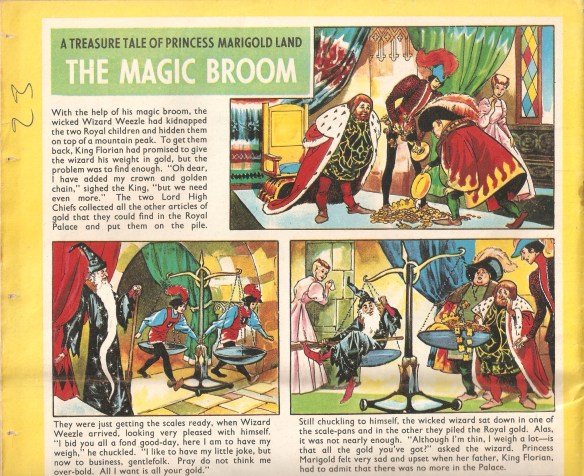
My final example of Treasure’s content is the start of the serial story in colour on the back page:

This seems entertaining enough, with the wizard’s partly comic, but perhaps also rather sinister pantomimic rhyming couplets, and the significant extent to which the lively pictures deliver the narrative, along with the concise captions beneath.

As the cover says, Treasure had a very clear ethos of learning through looking, hence the high and varied pictorial content – though there was also a good amount of chunky text to read too. This approach to pleasurable learning stemmed, as I now know, from the thinking of the juvenile editorial director, Leonard Matthews, at Fleetway Magazines, who in 1962 published, against initial opposition within the company, the first issue of a magazine for older young people called Look and Learn which worked exactly in the way the title announced (it continued in print until 1982 – see Look and Learn). At the same period as I was reading Treasure, my older brother was indeed reading Look and Learn, to which I in turn and in due course graduated. It was also a great read. I think Treasure was a very good choice on my parents’ part, and the copy I have bought has lived up to my memories of it. I recall my father saying he would never have learnt to read at all if it hasn’t been for The Magnet which he would have been reading in the early nineteen-thirties, so there was an inherent awareness of the value of comics (or ‘magazines’). I am very glad they paid for such Treasure to be delivered to our front door.

(Note: All images are scanned from the copy of Treasure in the author’s collection.)

‘Those Cheerless Cemeteries of Books’

The thrill of entering a public library. Thousands of books arranged in familiar patterns. Fiction and non-fiction. Classics and novels contemporary and historical, romances, crime stories and thrillers, sci-fi and fantasy. Books about art, science, music, history, travel, philosophy, politics. What will I find this time? Something entirely new? a much-anticipated sequel? an old friend? Each visit is a promise.

At the beginning of the 20th century, public libraries, including Sheffield’s, looked very different from our ‘open access’ model, where the books are there for us to wander through, to pick up, to choose or return. Then, while there might be a few out on display, many public libraries hid their books away behind counters, or kept them out of sight in rooms marked ‘No Entry’. Catalogues, often out-of-date, were set out in the public area, and sometimes copies could be purchased. Borrowers would seek the advice of library staff. Once a book was chosen, an assistant checked on its availability and, if it was not already on loan, retrieved it from its shelf and handed it over to the borrower.   

The Sheffield Corporation have given a good deal of attention lately to the development of the public libraries on modern lines, and evidence of the progress that has been made will be forth coming to-day when the Central Lending Library will be open for view to the public on the open access system. … (Sheffield Daily Telegraph – Thursday 1 June 1922)

From an anonymous pamphlet, The Truth about giving Readers Free Access to the Books in a Public Lending Library (1895)

With the exception of research and specialist institutions, there must be few ‘closed access’ libraries now. Why was it the norm in the early days? Maybe librarians and library authorities had little faith that books would not be disordered, damaged or even stolen by borrowers. Controlling access was a way to safeguard books owned by local ratepayers, not all of whom were happy with their money supporting the, to them, wrongly named free libraries. Perhaps there was also some attempt to influence what people read. Librarians and councils habitually worried about borrowers preferring the light novel over the serious work. The public library was, after all, invented to help people improve themselves.

Sheffield Central Lending Library 1910, with books locked away behind the counter (Courtesy of Sheffield Libraries and Archives – www.picturesheffield.com.
Ref: s02145)

As well as keeping borrower and book apart, closed access often meant problems for library staff. Book stores generally seem to have been crammed with shelving from floor to ceiling and young assistants had to scurry up and down long ladders to find books. Here is Joseph Lamb, Sheffield’s chief librarian from 1927 to 1956, on his days as an assistant:

Birmingham Central Library in those days (1913-14) was a murderous place in which only those with sound bodies and hardened minds could survive. Most of its large stock was shelved in three tiers of iron galleries reaching to the ceiling. In a closed library with an average daily issue of 900, the amount of leg work demanded of the staff was enough to qualify them as Everest climbers. (J P Lamb, Librarian While Young, The Librarian and Book World, Vol XLV, No 3, March 1956)

Opening of the Birmingham Central Free Library. Illustrated London News. Sept 16, 1865, page 256 (public domain). The ‘cheerless cemeteries’ can be seen on the left, with ladders for the staff to climb up and down.

And Sheffield librarian Herbert Waterson, who started work in 1869, hinted at the particular problems the ladders meant for Victorian women seeking library work.

Closed access inspired a piece of Victorian technology, the ‘indicator’. This was a screen, often fixed to the wall and divided into tiny sections, each matched to a book listing in the catalogue and showing if the book was in or out. The Sheffield Daily Telegraph proudly described the locally-made model installed in the new Brightside Library in 1872:

… the handsome mahogany frames on each side of the lending counter, in which is arranged what known as the ‘Indicator System,’ whereby the reader may see at glance whether the book he wishes to borrow is available or not. The system is ingenious, yet so simple that all can understand it. … (Sheffield Daily Telegraph, Saturday 17 August 1872)

The Cotgreave model of indicator
(from A L Champneys, Public Libraries (London, Batsford, 1907))

Indicators were often very large and could be unwieldy. The ones made in 1876 for the Upperthorpe and Highfield branches had the capacity for 12,000 books each. One of the Highfield assistants claimed that the staff used to play football behind their screen when the librarian was not on duty.[i]

Open access in a public library was trialled as early as 1893 at Clerkenwell in London by James Duff Brown and seems to have aroused considerable opposition.[ii] It began slowly to be adopted, as the objections to it were proved baseless. But in conservative Sheffield closed access was the order of the day until after the First World War. In two places only could borrowers roam at will among the books. The branch library at Walkley, which opened in 1905 with a grant from philanthropist Andrew Carnegie, was converted to open access in 1913-14 by its pioneering librarian, Albert Ibbotson. His superiors objected but he got away with it. ‘The [open access] Walkley Library’, said a letter from Mr A Ballard to the Sheffield Independent on Tuesday 16 August 1921, ‘has been for the past seven years a veritable university to the working people’.[iii] At the same time, two schoolteacher members of the Council’s library committee petitioned successfully for the opening up of the Reference Library.[iv]

These were among the few innovations in Sheffield Libraries in the early years of the 20th century. By 1921 the service was in decline, and there was much muttering in the press. The numbers of books borrowed were falling, book stocks inadequate, administrative practices old-fashioned, staff demotivated and buildings (especially the Central Library) in poor repair. New chief and deputy librarians – R J Gordon and J P Lamb – were recruited to put things right. Determined and modern, they wasted no time.

Converting all the libraries to open access and introducing the Dewey classification system, as funding allowed, was an early decision in July 1921. The task was huge but, by the following June, the necessary alterations had been made, the stocks of books refreshed and classified. The new open Central Lending Library was ready. Albert Ibbotson from Walkley had been appointed to run it in 1918 and was probably an ally for Gordon and Lamb. He had been described by the Sheffield Daily Telegraph on Friday 8 March 1918 as a ‘progressive librarian’. By 1919 he had already introduced a very limited form of access: ‘…two cases in which the latest books are always placed on view, and the rapid demand for these volumes shows how useful the system is’ (Sheffield Daily Telegraph – Saturday 6 September 1919).

No doubt primed by Gordon and Lamb, who both knew the value of publicity, the Sheffield Telegraph was eager to explain the new system to the city:

At the Library entrance is the staff enclosure where the issue records are kept and from which the staff control the entrance and exit wickets. A borrower desiring to change a book hands it to the assistant at the entrance counter, which is to the left on entering, and receives his borrower’s ticket exchange. The assistant then releases the wicket gate and the borrower enters the stockroom to select his book. After selecting the book he wishes to borrow he returns to the assistant who completes the necessary records and releases the exit wicket for the borrower to go out. Apart from this arrangement which will be greatly appreciated by borrowers, who can wander at will among the volumes, there is a new system of classification which makes for rapid working and ease of selection. As most borrowers at Public Libraries ask for books on a particular subject rather than by the author, and because of the many advantages gained by having all the books on the same or related subjects on one shelf, the books have been classified according to the subjects they cover. The Dewey Decimal classification has been used for this purpose and seeing it in operation, one is impressed by the value of the system. The books in the Library are arranged in two parts: prose fiction and non-fiction. (Sheffield Daily Telegraph – Thursday 1 June 1922)

Sheffield’s Attercliffe Library after conversion, showing the staff enclosure, the wicket gates to control access and the open shelving (Courtesy of Sheffield Libraries and Archives – www.picturesheffield.com. Ref: u01383)

The degree of detail suggests how much of a change this was. The journalist goes on to say: ‘There is no doubt that the public will appreciate the new system, under which borrowers are allowed actual contact with the shelves containing the books.’ Over the next few years, Sheffield’s branch libraries were all converted, with counters and screens removed and new shelving installed.

Borrowers in later years clearly still appreciating open access (Courtesy of Sheffield Libraries and Archives – www.picturesheffield.com. Ref: u02265)

Open access libraries are so familiar to us that any other system seems impossible. But in 1956, as J P Lamb approached retirement, he saw some merit in the old ways:

It seems to have been my library lot in my younger days to be fully occupied in re-organising old type libraries. Those cheerless cemeteries of books are now thought to have no redeeming features; but reflecting on my work in them after a lifetime spent in creating ‘modern’ mass appeal libraries, I am not at all sure that the change has been wholly good. Open access has resulted in the loss of a personal contact with the reader, which no kind of readers’ advisory system can replace. … The librarian as guide, philosopher and friend was then a reality. … (J P Lamb, as above)


[i] From Kelly, James R, Oral History of Sheffield Public Libraries, 1926-1974 (unpublished MA thesis, University of Sheffield, 1983). A copy is held in Sheffield Archives.

[ii] Kelly, Thomas, History of Public Libraries in Great Britain, 1845-1965 (London, The Library Association, 1973), pp. 175-82.

[iii] Did Mr A Ballard become Alderman A Ballard CBE who chaired the Council’s Libraries Committee between 1944 and 1954? It seems very possible.

[iv] The City Libraries of Sheffield 1856-1956 (Sheffield City Council, 1956). Along with the newspapers quoted, this is the main source for this article.

Val’s Reading Journey: Word Games

Another instalment of my reading journey, in which I confess my affection for dictionaries and grammar books.

Forty years ago, I was a student at the University of Leeds, studying Latin and French. I was, then as now, rarely without a book in my hand and a spare in my bag: set texts and academic studies for my courses and novels for fun. With all that, it intrigues me that I have very clear memories of the reference books I used. I even feel affection for them.

The Parkinson Building

On most Saturday mornings back then, I would be found in the Brotherton Library. I used to climb the white stone steps into the Parkinson Building, cross the court to the library entrance with its creaky turnstiles, and walk into the main reading room. Turning sharp left, I went upstairs to the gallery, where Classics was shelved. The main undergraduate library was then the South Library, long renamed the Edward Boyle. But I always preferred the Brotherton, opened in 1936 and since 1950 peacefully hidden behind the Parkinson.

hic haec hoc
hunc hanc hoc
huius huius huius
huic huic huic
hoc hac hoc

I came to the Brotherton to work on my Latin prose. Every Friday we got a passage of English to turn into Latin – something philosophical, a political speech or maybe military history. Burke, Locke, Gibbon, Macaulay are the names that come to mind. I think there may also have been occasional old leaders from the Times. Writings by women never featured. Whoever the author was, I would in theory have done a rough draft at home on the Friday afternoon. Saturday morning in the Brotherton was for polishing, looking up words and phrases in Lewis and Short, and checking out, say, the optative subjunctive in Bradley’s Arnold or, if I was desperate, in the small print of Gildersleeve and Lodge. These are, respectively, a Latin dictionary and two grammar books. I have my copies still, shelved about six feet away from the sofa where I am typing this.

Written in 1867 by the grandly named Basil Lanneau Gildersleeve (1831-1924) and revised by him and Gonzalez Lodge (1863-1942) in 1895.

These books are always known not by their titles but by their authors. Our prose tutor never mentioned Bradley’s Arnold, quoting instead from Mountford. We were all mystified, and it was only by chance, halfway through the term, that we found out he meant Bradley’s Arnold all along. Theologian Thomas Kerchever Arnold (1800-1853) wrote it in 1839. Then, you see, George Granville Bradley (1821-1903), Master of Marlborough, later master of University College, Oxford and Dean of Westminster, revised it in 1885. Finally, the Vice Chancellor of the University of Liverpool, Sir James Mountford (1897-1979), revised it again in 1938. Impressive chaps.  

Mountford’s Bradley’s Arnold

Ut, Ne, Introducing a Noun Clause: One of the main difficulties in translating English into Latin is to know when to represent the English infinitive by a Latin infinitive, and when to use  a subordinate clause containing a finite verb. (Bradley’s Arnold, para. 117, p.83)

As well as these august publications, I found that I still relied on my school books: Latin Sentence and Idiom (1948) and Mentor (1938) by schoolmaster R A Colebourn. Comfortingly familiar, they were a gift from my Latin teacher when I left school. ‘In memoria temporum beatissimorum cum benigna tua magistra’ (‘remembering the happiest of times with your kind teacher’), she wrote inside the cover. Why I don’t have Civis Romanus, the companion book to Mentor, I just don’t understand. (Mem to self: check Abebooks).

Two more books on my shelves are Kennedy’s Revised Latin Primer (1888) and Meissner’s Latin Phrase Book. I never liked Kennedy much but it is the book perhaps most often associated with learning Latin. It turns out that it was not written by schoolmaster Benjamin Hall Kennedy (1804 – 1889) but by his daughters Marion and Julia and two of his former students. The Phrase Book is an English translation by H W Auden, a master at Fettes College, from the original German by Carl Meissner (1830-1900), and my battered copy dates from 1924. It helpfully runs from the philosophical to the practical.

Choice – Doubt – Scruple: unus mihi restat scrupulus (one thing still makes me hesitate) (p.83)

Victory – Triumph: victoria multo sanguine ac vulneribus stetit (the victory was very dearly bought) (p.269)

The king of all dictionaries was Lewis & Short, first published in 1879. I never knew until now that Short lived down to his name: he supplied only the letter A and Lewis did the other 25. At first I used one of the Brotherton’s copies but in 1981 I got my own. In a medieval Latin exam we were allowed to take in our dictionaries and, while the Latin of the Middle Ages is not difficult after you’ve done Cicero or Virgil, I carried in all 2.7 kg of my Lewis & Short, just for the pleasure of having it on the desk. ‘Really?’ said my Latin tutor, eyeing it up as we started. 

The Brotherton Library naturally had a set of Loebs, those blessed books with the Latin or Greek text and the English translation side by side. Red covers for Latin and green for Greek. The translations were often pedestrian but so very useful when you got stuck. The older editions of the naughtier poets are said to have passages translated into French, rather than English, presumably on the grounds that if you understand French, you must be pretty immoral anyway. 

Unbound – and hard to keep in good condition

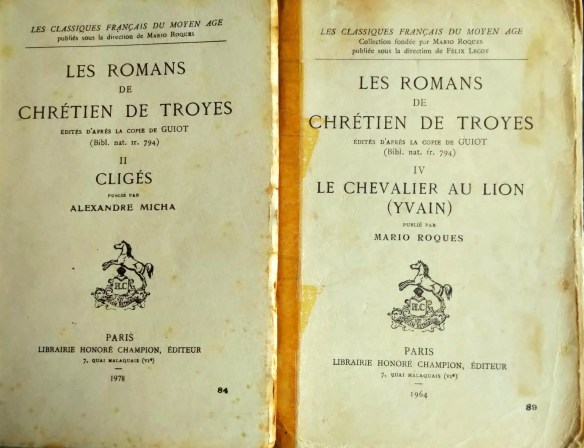
Being happiest with dead languages, I also studied Old French and Old English. In Old French, it’s really the texts I remember: unbound and uncut editions of the Arthurian romances of Chrétien de Troyes from the French publisher Champion. ‘The idea,’ said my supervisor, ‘is that you get them bound yourself.’ A pause. ‘I always have my own books bound in episcopal purple.’

Cil qui fist d’Erec et d’Enide,
Et les comandements d’Ovide
Et l’art d’amors an roman mist
Et le mors de l’espaule fist
Del roi Marc et d’Yseut la blonde
Et de la hupe et de l’aronde
Et del rossignol la muance,
Un novel conte rancomance
(Cligès by Chrétien de Troyes, ll. 1-8)[i]

(I did have to look up a couple of words in my Larousse Dictionnaire d’Ancien Français to translate this quotation just now.)

For Old English, it’s all about Sweet’s Anglo-Saxon Primer and his Anglo-Saxon Reader. Henry Sweet (1845-1912) was a philologist said to have been an inspiration for Bernard Shaw’s Henry Higgins.

Ælfred kyning hateð gretan Wǣrferð biscep his wordum luflice ond freondlice; ond ðe cyðan hate ðǣt me com swiðe oft on gemynd, hwelce wiotan iu wǣron giond Angelcynn, ǣgðer ge godcundra hada ge woruldcundra… (King Alfred, On the State of Learning in England, Anglo-Saxon Reader, p. 4)[ii]

I also have a little book, An Outline of Old English Grammar (1976), especially written for Leeds’ English students. ‘Old English is a fairly fully inflected language,’ it starts. Quite.

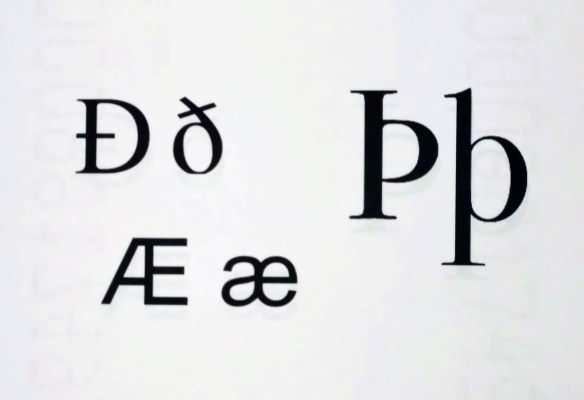
Eth, thorn and ash – letters lost between the Anglo-Saxons and us

I don’t know if Sweet, Kennedy, Bradley’s Arnold and the rest are still standard texts. Perhaps they are somewhere. Dead languages don’t change. But the way of teaching them may well have. Mountford, Sweet and the rest are, well, a little dry and can seem almost as old as the texts they teach. The books I relied on may therefore by now have been carried down into the Brotherton’s stacks. Forty years ago, for me they unlocked epics, romances, speeches, philosophy and histories.

A few years ago, when I needed access to a university library, I travelled back to Leeds, to the Brotherton, to get a graduate library membership. I walked from the railway station, along Park Row, across the Headrow, past the Town Hall and the Central Library on the left, and up Woodhouse Lane to the university. Then up the Parkinson steps, across the court and into the reading room. I could see many differences. In my day, there was usually a porter on duty at the turnstiles, and now of course there were computer terminals everywhere, and they seemed to have moved the Classics books. But much was as I remembered: the huge circular room with wooden tables radiating outwards like spokes, the dome supported by green marble columns and, at the centre, wonderful Art Deco lighting known, I learn, as an electrolier. As I arranged my ticket, I mentioned to the librarian that I used to do my Latin prose in the Brotherton most Saturday mornings. ‘Welcome home,’ she said to me, as she handed me my new ticket.

Image by Cavie78, licensed under Creative Commons Attribution – Share Alike

[i] He who wrote of Erec and Enide, he who translated the commands of Ovid and the Art of Love, he who wrote of the shoulder bite. of King Mark and the fair Yseult and of the transformation of the hoopoe, the swallow and the nightingale, he is starting a new story…

[ii] King Alfred orders greetings to Bishop Waerferth with his words in love and friendship. I want you to know that very often I think what wise men there used to be throughout England, both in the church and out in the world…

A Light To Read By

On those rare occasions when there is a power cut, we blunder around, doing silly things like trying to switch on lights so we can look for candles and matches. It’s automatic. We are so used to electricity lighting our homes, shops, public buildings and streets. But there was a time, in the late 19th century and early 20th, when electric light was new technology, even a thing of wonder.

They made an occasion of it, and Sheffield’s principal newspapers, the Independent and the Daily Telegraph, carried short reports the next day. On a September evening in 1901, the members of the Council’s Libraries Committee made their way to Brightside Library, on the north of the city, to switch on the lights.[i]

In 1901 there were four branch libraries in the city: Attercliffe, Upperthorpe, Highfield and Brightside. The newspapers didn’t say why Brightside, the first purpose-built library in town, opened in 1872, had been chosen for the high-tech transformation from gas to electric. Perhaps its relatively small size made it suitable for an experiment. From about 1880, thanks to inventors like Joseph Wilson Swan and Thomas Edison, electric lights were slowly becoming more common in both private homes and public buildings. In Sheffield, an electricity supply business was set up in 1892, and taken over by the Council in 1898. Maybe there was an expectation that, as time passed, Council buildings would all enjoy modern lighting.

Brightside Library. The name was eventually changed to Burngreave but the building remained a library until 1990. It is now the Al-Rahman Mosque.

On the night of 11 September, the switch was thrown in Brightside by Councillor George Taylor, of the Libraries Committee. He was the Liberal councillor for nearby Attercliffe. The Independent said of him in 1902 that he was ‘a round, comfortable councillor’ and a ‘very advanced Radical’ who ‘raps out his opinions “in straight-flung words and few”. If you don’t like them you can lump them.’ ‘He has served Attercliffe well,’ was the newspaper’s conclusion.[ii]

At Brightside, Councillor Taylor ‘made a few remarks in which he set forth the advantages…’, the Independent reported.

For some time there [had] been a desire to provide a better light at the branch libraries…The committee [hoped] to effect considerable saving in the way of bookbinding, as well as benefit to the health of the readers by the purer and cooler atmosphere gained by the exchange from gas. [iii]

Councillor Taylor was right about the advantages.  

  • Only a week before the Brightside ceremony, the Sheffield Weekly Telegraph had included a report by the Society of Arts’ committee on bookbinding. ‘There is a general agreement’, it noted, ’that the use of gas in libraries has most deteriorating effect on the bindings – the electric light being preferable.’[iv]
  • Six years later, in his book, Public Libraries, the architect Amian L Champneys listed the disadvantages of the various types of gaslight: overpowering smells, soot, unsteady and/or poor illumination, easily broken mantles [the part which lights up when heated] and, worst of all, ‘noxious products, viz., carbonic, sulphuric and sulphurous acids, and the dry heat’ which could be ‘extremely injurious’ to readers, staff and books alike. (pp. 14-15)

Champneys was clear that electricity was by far the better method.

The advantages of the electric light are that it heats the air only to a very slight degree, and vitiates it not at all; while the danger of fire, if a proper sub-fuseboard system [is used], is less than with any other method. The extra cost is to a great extent balanced by the resultant economy in depreciation of leather and cloth bindings, in cleaning, sick-leave, insurance, and redecoration. (p.17)

Example of lighting from Champneys’ Public Libraries (p. 19)

The Telegraph noted that the Brightside ‘experiment apparently met with general approval’ and expected that the bigger library at Upperthorpe would be next, with Highfield and Attercliffe to follow. The Telegraph’s reporter must have spoken to someone else, for he thought there were no plans yet to tackle all the branches.

It’s interesting that there is no mention anywhere of converting the Central Library. Was it too big and expensive a prospect? Or was the building, dating from 1832, just unsuitable?

This story seems to end here. I can find no other press records of installing electric lighting in libraries in the early years of the 20th century. Were Upperthorpe and the other libraries converted shortly after Brightside? There may be more sources to be checked when COVID-19 restrictions relax but for now, that’s it.

What does seem certain is how innovative the Council was being in fitting electric lighting in Brightside in 1901.

A sign in Deschutes Historical Museum, Bend, Oregon, USA. Image by Frank Schulenburg. Licensed under the Creative Commons Attribution-Share Alike 4.0 International license

[i] Sheffield Independent and Daily Telegraph on Thursday 12 September 1901.

[ii] Sheffield Independent on Wednesday 13 August 1902.

[iii] Sheffield Independent on Thursday 12 September 1901.

[iv] Sheffield Weekly Telegraph on Saturday 7 September 1901.

Charles Dickens in Thirties Sheffield

By Mary Grover

In October 2020, I gave a talk to the University Women’s Group about Sheffield readers and the novels of Charles Dickens. It gave me the opportunity to reflect on my own relationship with Dickens. You can find the full talk, with slides, under our Research tab here

Unlikely as it may seem, in the 1930s intellectuals and academics such as the influential Q D and F R Leavis often dismissed Charles Dickens as an author for the uneducated masses. That assessment was strengthened when popular newspapers, fighting a circulation war, offered their readers relatively inexpensive sets of Dickens in presentation bookcases, making his novels available to a vast number of people. My father, who lectured on English Literature, grew up in the 1930s, in a modest home with one of those – in his case, treasured – sets of Dickens. 

My father, David Yorweth Morgan, in Rangoon in 1954

In 1934 the Daily Herald got the ball rolling with the first subscription offer: eighteen volumes for eleven shillings, a saving of 69 shillings on the market price. Frank Burgin, who grew up in Mosborough in the Thirties, described the process.

A man came round to the house getting you to buy the Daily Herald.  My father said, ‘We’ll never use that newspaper because we don’t agree with those politics’, but eventually, the man must have been good, because he signed up so I got the whole of Dickens’ works with that newspaper.

For all that he remembered acquiring the novels, Frank was no great fan. But many other Reading Sheffield interviewees loved Dickens. Dorothy, for example, who saw poverty as she grew up in working class Sheffield, responded powerfully to the story of Oliver Twist, ‘the way he was treated’. Betty Newman, who in general dismissed novels, thought Dickens ‘was the nearest I got to fiction’ and concluded, ‘I don’t think he really is fiction’. For Dorothy, Betty and others, Dickens dealt in harsh economic realities which they recognised. They learned history from him. ‘It gave you an insight into just how unfortunate some people were and how they lived,’ said Peter Mason.

For others, it was Dickens’ vivid characters, like Mr Micawber and Magwitch, that captured the imagination. The frequent dramatisations and readings on BBC radio programmes of the period reinforced this. In 1930, for example, Bransby Williams, ‘the Famous Portrayer of Dickens Characters’, led a musical extravaganza, ‘A Pickwick Party’, subtitled ‘A Dickens Dream Fantasy’ with a ‘Chorus of Dickens Dogs and Dainty Ducks’. 

In time academics like the Leavises changed their minds about Dickens. He was deemed a worthy subject for study, much to my pleasure, as I was brought up surrounded by my father’s Daily Herald copies of the novels. For eighteen years Dickens was a constant physical companion and, in my teens, an imaginative one.

My father’s set of Dickens, still in their presentation bookcase

For my father and thousands like him Dickens made reading and rereading, affordable and pleasurable. And it was the pleasures he delivered that enabled many unschooled children to get the reading habit.